Calm at minute one, predictable by minute four
The playhead reaches the end and snaps back to zero. After a few passes your ear spots every landmark.
You know that moment at two in the morning when you are finally drifting off to a rain track — and right around minute four, a tiny click or an identical wooden chime jolts you awake because the MP3 just started over. Estua throws away audio files altogether. Beneath its quiet interface runs AURA, a C++20 synthesizer composing each note and breath of air fresh on your device.
No account required. Zero tracking. Android build in progress.
AURA watches context signals to gently steer toward calm rather than mirroring stress back at you. Drag these while audio is playing.
Estimated time before pitch chains and chaotic phase trajectories ever cross the same starting state again.
Mean melodic surprise across 10 independent seeds; 99.3% of 4-note phrases are strictly unique.
Host stress benchmark running 100 voices at 48 kHz (200.23 µs mean per block, zero underruns).
All synthesis stays in local C++20. Nothing streamed from a server, no ad SDKs, no cloud listening history.
Neuroscience calls it predictive coding: the better your auditory cortex learns a recording's pattern, the harder it stays awake bracing for the seam.
Most sleep and focus apps still behave like pocket cassette players: three minutes of recorded rainfall or warm piano chords faded end-to-end on repeat. For five minutes it feels effortless. Yet human hearing evolved to scan nature for structure — within a handful of cycles your brain memorizes the thunder dip at second 42 or the muted cadence at the barline, silently counting down until it comes back around.
Wait-for-the-loop fatigue burns the exact attention you opened the app to rest. Instead of storing multi-gigabyte stems, Estua synthesizes acoustic physics live across 45 C++20 modules right inside your phone's memory.
Think of a good storyteller who remembers the last two sentences to choose a natural third one without reading from a script: AURA guides harmony through an order-2 Markov chain, while Lorenz chaos equations gently drift wind wash, brightness, and timing by a few percent every breath so hour three moves like embers or foliage rather than a playlist.
The playhead reaches the end and snaps back to zero. After a few passes your ear spots every landmark.
Over 15 physically modeled instruments plus optional HRTF headphone space. No repeat boundary anywhere for your ear to brace against.
Instead of jarring random notes or frozen sheet music, AURA reads the last two played tones and draws the calmest next interval from an INT8 table cached right inside L1 CPU memory.
Edward Lorenz's atmospheric equations steer filter warmth, wind breath, and bow drift smoothly without ever settling into a closed loop — closer to real fireplace embers than an audio GIF.
Subtle controlled micro-noise softens digital brittleness while outer-ear acoustic cues (HRTF) place instruments gently around your room instead of pressing inside your skull.
Tap any listen button below to jump straight up to the live synthesizer and compare how pitch density, filter openness, and voice color shift.
Shaves off sharp transients and bright upper harmonics. Sub-bass warmth breathes smoothly until the timer gradually dims to quiet without waking you.
Built for closing the laptop or riding home late. Felt keys and airy strings take warm 6th and 9th voicings — unhurried without ever turning gloomy.
Refuses to compete for your verbal attention with catchy hooks. Combines smooth pink-spectrum floor masking with sparse plucks so café chatter fades behind the page.
Made for the half hour after an overwhelming afternoon. Rather than flashing a strict stopwatch at you, the swells slowly align with a calm breathing cadence.
25 distinct sound palettes per mode — forest rain, ceramic bowls, felt piano, distant strings — or switch on Living mode to follow your day.
Loved the combination you stumbled into this morning? Share its short Seed tag or export a clean WAV keepsake straight from the app.
A brief in-app hearing check profiles your own ears and headphones so warmth stays rich at low, comfortable bedside volumes.
Unretouched screenshots taken straight from Estua on iPhone.
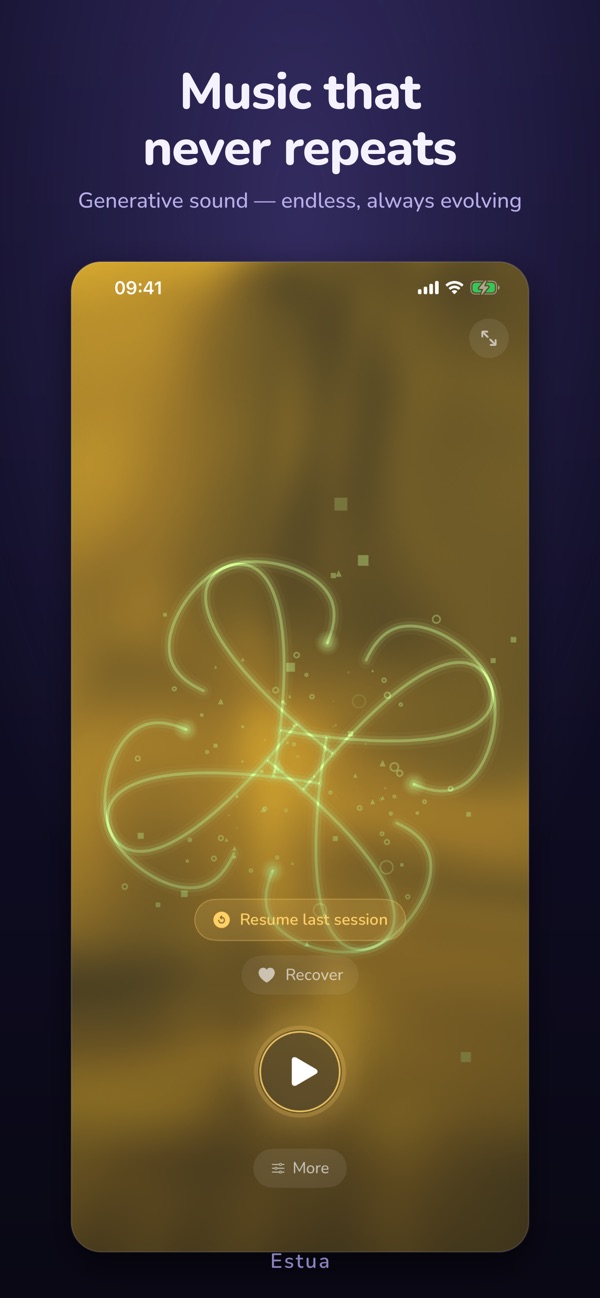
Open Estua, pick a state, tap play. No onboarding maze, no forced account wall.
Across a 30-seed ablation study on AURA, one feature sounded clever on paper yet measured flat in output statistics. Here is both sides unedited.
With chaos turned off, filtered ambient layers still leave slight residual waviness over long runs. Enabling Lorenz modulation drops peak periodicity significantly without adding a wobble of its own.
Triggering on 20.9% of notes to smooth leaps looked great in theory, yet 30-seed runs scored 3.535 vs 3.536 bits. We kept it strictly as a gentle step-size nudge and documented the null result rather than pretending it boosts variety.
No heap allocation, no locks, no unbounded loops on the audio thread. Even pushed to 100 voices under production voicing on host, blocks finish in ~200 µs out of a 5,333 µs budget.
Honest scope notice: Estua and the AURA engine are general wellness tools for relaxation, focus, and unwinding — not a medical device, and not intended to diagnose or treat sleep disorders or health conditions.
Yes. There are zero cloud audio files or streaming dependencies — every sample at 48 kHz is computed directly inside your device's memory.
Yes — it is the same C++20 AURA codebase compiled to WebAssembly. The iOS app adds all 100 voiced styles, 8-band ear calibration, Keepsake WAV export, and optional on-device Apple Health & mic context adaptation.
AURA's generative probabilities stem from a deterministic seed state. Passing a short Seed code tells another Estua install how to initialize its Markov chain and chaos state so the exact phrasing unfolds identically.
The shared C++ core and Kotlin parity app live side-by-side with iOS in the same repository, and Google Play packaging is currently being finalized.
Estua is available now on iPhone and iPad. Or leave this tab playing Relax or Focus while you get on with your work.